Showing posts with label Alan Moore. Show all posts

Wednesday, August 18, 2010

Alan Moore: Swamp Thing, Alan Moore's Writing for Comics


I finished Alan Moore's Swamp Thing and Writing for Comics as the next couple items in my Moore stack. I don't really have a scheme or patter for choosing to read what I read and in the order I read it. Because the things I have to say about works are, unfortunately, short, I've combined the two books into one post. You can thank Apple's hopelessly useless Safari program for this double feature. Some misguided times I try to use the stupid thing, and it crashes without fail if I try to do more than one thing quickly. For example, browse the internet AND have the computer on, or go to a website and sneeze. I should always use firefox.

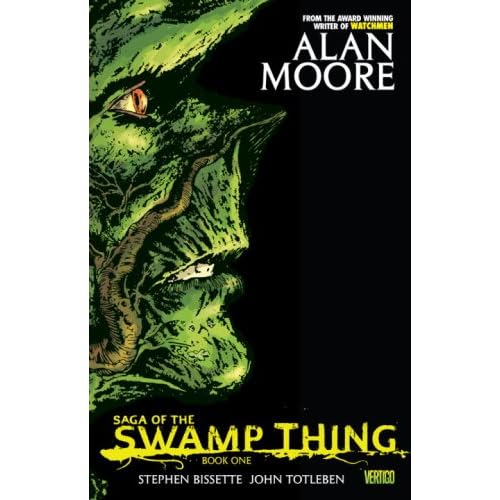
Swamp Thing I'd always avoided. I watched the cartoon a little bit as a kid and had a few of the toys, my favorite being the one that turned bad guacamole dark green when cold and good fresh guacamole green when hot, like in water or sunlight. I'd always preferred Marvel's Man-Thing, who was innately more ethereal and based in horror tales about demons and forest spirits and stuff. Man-Thing came first, and Swamp thing about a year later. I knew someone was stealing from someone. Ultimately, I guess it was DC who stole from Marvel.

As far as I know, Swamp Thing started out as a Science Gone Wrong vaguely environmental warning. A man, Alec Hammond, ends up getting reconstituted as plant matter through the combination of dirty swamp water, a secret chemical compound, and an explosion. I had no interest. When I read about a year of Alan Moore's take, where Swamp Thing becomes a sort of lesser spirit god, my interest was piqued. My guess is that that's something Moore builds on later, because it was mostly vacant in this book. This book did have a reinvention of his origin – instead of Alec Hammond simply becoming a thing made of old roots and leaves, he dies, and his soul (more or less, the book doesn't use these words) inhabits the roots, and with the aid of that special serum, a man shaped plant thing with the memories of a dead human comes into being. In this book he fights one lunatic who wants to destroy the world with plants, and a demon. The setup for forest god is easily forseeable.

Moore works in homages, as established in the last post. So I'm going to get that out of the way first: the second story involves a battle with a demon named Etrigan, a Jack Kirby creation, complete with a dedication to Jack at the end of the book. The art is also an homage to the old Creepy Comics style artwork: very scratchy, lots of lines. The art fits the book perfectly, and I stopped many times to admire the artists' (though I think the inks show better than pencils) skillful rendering of haunted plants. It really reminded me of Sam Kieth's run on Sandman.

As far as story is concerned, this one was much more straightforward than probably any other Moore book I've read. There wasn't a fleet of characters to remember, and they're introduced in small groups allowing you to easily file it away. Since Moore wasn't there since the start, there are a lot of en medias res characters that I had to build partial profiles for simply because I wasn't there from the start. The book really only has about five characters to keep track of, which is much easier than Tom Strong's ever growing cast, or Watchmen and League's ponderous casts.

I don't really have much else to say about this one. It didn't have as much Moore token weirdness, though I know he takes it in a progressively darker and inward direction. I don't even really know if this was worth typing because there weren't many Moore techniques I could mine or anything. I honestly found myself more routinely impressed by the art and less by the story. Maybe when I read following volumes I'll have more interesting things to report.
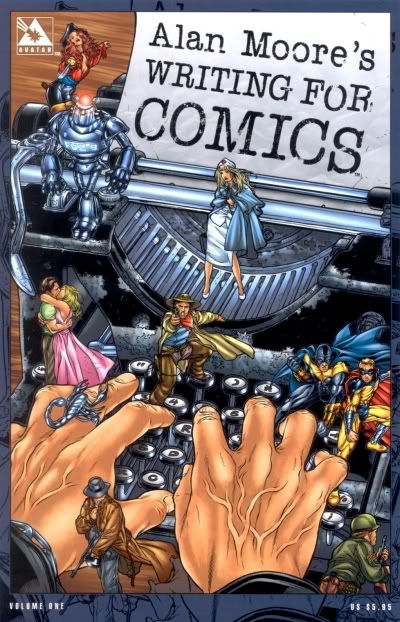

I was really looking forward to Alan Moore's Writing for Comics, but I was kind of disappointed. There's a series of perplex things happening with this book that I first want to address. The first is that it's almost five years old and it says volume one on the cover, and there is no sign of a volume 2 having ever existed in the history of ever. The only publication date listed in the book is 2006, but an afterword letter dated in 2003 references the work as being fifteen years old, which isn't inherently awful, but I feel in some way slighted – like the book was trying to deliberately keep the piece's age away from my attention. So apparently it was written in 1988 though nothing about the book's afterward and simple math belies that impression. Whatever.

The next thing is the art. I'm not sure why it's there. Maybe so the reader doesn't forget that Alan Moore draws for the funny books? But that makes no sense because if you're reading this book, there's no way you don't know who Moore is. And the art's pretty awful. It's not awful in the Dirty-Hippy-At-ComiCon-Who-Tells-Me-I-Don't-Even-Have-To-Know-How-To-Draw-To-Make-Comics kind of awful, though his art is among the worst I've seen seek publication, but awful in the Art-Is-Such-Standard-Comic-Art-That-It-Almost-Feels-Like-It's-Making-Fun-Of-Itself kind of awful. And they have nothing to do with what Moore's talking about. It might be better if they in some way did, though I'm not sure how that'd work, but they're ridiculous. On page talking about pacing you have a gladiator in a little box, then in another page talking about the believability of the world there's a cartoon man being drug along on a leash by a cartoon dog in horrible generic cliché comic art. It's not even good. And it's so forgettable. The only art I remember is the very end which has a picture of a man and woman kissing, and it's only because I vowed I would remember one image by the end of the book, or my name wasn't whistling dixie, and I forgot until I got to that last image. It sucked like the rest.

The book itself wasn't all that hot either. I constantly felt like Moore was gearing up to tell me something amazing, but never quite got there. That might be the same sort of thing as Swamp Thing (whose art was AWESOME) wherein it's merely the first volume. Supposedly. Unfortunately, whereas Swamp Thing got to go on with more volumes, it appears Writing for Comics did not. Most of what Moore said are things that I internalized long ago. Maybe if someone who hasn't had as many writing classes as I had, or who hasn't been reading comics as long as I have, or someone who pays less attention than I had read this book they would have thought it was amazing. But a lot of felt like rehash. Which I wasn't anticipating. Moore tells us on the first page he doesn't want the book to be a “How To Write Like Alan Moore” tutorial, which isn't want I wanted, but I suppose I expected something a bit more exploratory than this books alloted forty pages. I was honestly expecting a novel when I ordered this book from the library.

Some of the things I had already internalized that Moore mentioned were things like making sure you realize what you're doing; everything has a purpose and when you break from that purpose, make sure you know why you're doing it. There were even some things that I know, but he worded in ways that made it a little more succinct in my mind (which was cool). For example, he said there's a different between story and plot. Story seems to be a larger more nebulous concept. In the literary world, it would be called theme. It's the thing that connects this particular story, or plot, to humanity at large. And even if you're dealing with something silly, like elves, makes it relevant to the human condition. Plot is the particular sequence of events in that story. To use a familiar example, Finding Nemo is a story about the nature of father-son relationships, whereas its plot would be about a little boy fish getting lost in the ocean and his dad trying to find him.

Another thing Moore talked about was scale. His advice was to imagine the large details of a story and progressively work towards the most exact details until all of a sudden, you have a story. Start with the world: the time, where it's located, all the factors that went into the world. What's it's political climate? Is there a war? What events happened in the past to form the current world? Is it a totalitarian world? Is it primitive? Do they love TV? On and on. He says this is the most time consuming part of story creation, but makes the rest go smooth and comparatively faster.

Next, you'd develop your characters: everything about them and how they fit into this larger scope around them. From there, the plot is essentially the natural expression of the world and characters over time. In my book I wrote that P=(W*C)/T. Moore's advice is to think of plot like a four-dimensional construct, where the fourth dimension as time: each panel or situation is a single 3D slice operating within a 4D construct. His writing about plot was the most informative and enjoyable of the book.

In a 40 page book I only took a page of notes. Which is not a very good rate. My sincere hope is that he visits this concept later with more information. Then it might not suck so bad. I guess we'll see.

Alan Moore's Writing: Tom Strong

As I mentioned in one of my previous blog posts, I'm trying to work through Alan Moore's entire corpus, or what of it I can get my hands on, before school starts in the interest of trying to absorb Moore's writing into my own. I thought a wise element of that would be to, on this blog, try to dissect some of Moore's tools hopefully distilling his craft into an ingestible tonic that will grant spirit powers. In the spirit of that, I just finished Tom Strong volume 1, the Deluxe Edition. A couple brief observations:

  • It's twelve issues long.

  • The issues appear denser than, say, a standard offering from DC or marvel.

  • Published by America's Best Comics, Moore's own line, which I think is distributed through DC.


Despite the fact that I really really dislike DC, I love their off-the-beaten-path stuff, like America's Best (of which I've also read portions of League of Extraordinary Gentlemen and Top 10) and I've never read a Vertigo comic I didn't like, most of which I loved. I don't know what it is about those English comic writers, but they are some clever and unabashed mothers.


So Tom Strong is kind of like Superman brought about through Batman means: he's incredibly strong, slow aging, and uncannily resilient, but it's mostly thanks to a special regimen of diet (slightly magical) and exercise. He protects a city called Millenium City from its many would be adversaries with the help of his wife, daughter, and talking gorilla friend. It's very much modeled after and feels like old comics. Which is actually the first Moore device I wanted to address.


Most of the issues in this first bound edition feature what Moore calls Untold Tales, which is a flashback into Strong's deep past (being 100 years old, it's extensive), the art and narration reflecting an appropriate comic genre. Moore is really big on homage. V for Vendetta was built up on a lot of literary and cultural allusions, V himself being derived directly from a significant part of England's history, and Top 10 is essentially a big love letter to a half century of superhero books with all the tropes and easily recognizable characters and situations. More on Top 10 some other time.


Tom strong lapses into a sort of Archie style whenever the comic focuses on Strongmen of America (his fanclub) number 2059, but the rest of the present stories have a very classic comic look. The coloring is very smart: the characters look very much like cartoons. In fact, one of the homage pieces is even in a mock Disney style.


The first flashback's style I don't totally understand. It takes place in WWII Germany, but nothing about the style looks Golden Age. In fact it looks very 90s, and it's even difficult to say why. It has a vaguely Joe Madureira or Humberto Ramos look to it, which might be why. Both artists gained prominence in the late 90s, and all the women are ridiculously out of proportion (90s comic tradition), which isn't in keeping with the bulk of the art. It definitely has a 90s feel, but I don't know why a WWII story is reflected. I'm stumped on this one. As near as I can figure, it might be an homage to some Captain America retooling that happened around this time, but apart from WWII there's nothing to really make you think of the Cap himself.


The second one is easy. Strong and wife Dhalua fall backwards in time and meet a giant creature composed of millions of algae cells that mimics both the biology and psychology of its prey, but living on Pangaea, before there were even reptiles, Strong and wife are the first chance it's had to mimic complex biology or physiology. A fight ensues, and Strong escapes safely. The art is definitely done in a Tales of Suspense faux-Scifi/horror art style, complete with a total lack of though bubbles, and every word being spoken outloud. Most sentences end with an exclamation point. The art looks very comic book, and is probably the style that comes to people's minds when they hear comic book.


The next homage is a flashback to a Riddler type character that likes to kill the hero in complex Rube Goldberg situations. The art is pure Detective Comics. I wish this one had gone a little further, losing the modern six color process and adopting a more era appropriate three color process. Things look too vibrant for a comic mimicking a nearly 80 year old style.


There are other homages – western, Disney, and horror included, complete with Lovecraftian scratchy pen renderings, and narration that's contained entirely within paragraphs, more like an illustrated book than a comic. That one was the most striking as it presented the greatest deviation from the art. Tom looked a little stupid and out of place though, as his rendering wasn't as scratchy, but with everything else looking so victorian and rough, almost like a woodcut, he looked cartoony and ridiculous. And of course there's a Kirby homage. If you have the words Comic and Homage in a single sentence, it will invariably include Kirby. Kirby is to comics what Jesus was to religion. Just saying.


So apart from very careful homages makes Tom Strong worth reading? Well, at first glance, not a lot. At first glance.


The comic feels like it tries to start both en medias res and at the beginning, as if after having heard of Superman your whole childhood you decided to read his first issue. It almost feels like as if on a meta level, the reader is expected to already have knowledge of the person contained within the comics, which is sort of what's happening. The first issue is a split between 2059 (referenced above) reading his comic initiating him into Strongmen of America, and the comic he's reading: Tom Strong's origin. A clever device, but it makes getting into the book a bitch. If I wasn't turning Moore's writing into a project, I would have put the book up. And I did. I first tried reading this book about a year ago. I should have known then to push through, because honestly, when has a Moore book let you down? Never is the correct answer.


Nevertheless, I hate it when books just open up by throwing names and places at you. Few things make me want to learn about them less than having to keep track of names of people and places before I'm given a reason to care about them. Watchmen was expert in that way: it revealed a character at a time, peeling back the layers of characterization back like an onion. It opened with an exciting murder scene, which gives you the incentive of learning about who these characters are.


Another thing that made the book difficult is that the first two issues feature barely any Tom Strong. The first book features him only in exposition inside the comic in a comic, while the second one features his daughter, Tesla, and his Gorilla, Solomon, trying to understand this bizarre machine symbiote. He only shows up at the end to deliver a spoonful of Deus Ex Machina. Related to this is the fact that we watch his supposed greatest nemesis die in a single panel without seeing any of the conflict or who his villain is. By the time I got to issue three, I was using lots of will power to get through it. I wasn't even sure if this comic had real characters, but like any Moore comic, he starts to administer hook after hook and there's no getting free.


It's hard to say how Moore did it, but by issue four when we meet Strong's opposite in gender and philosophy, I felt like I knew how Strong would react to situations, the kind of character he was even though the amount of character revealing dialog is kept to a strict minimum. The third chapter about space faring dimension hopping Aztecs with a quantum computer bound Quetzalcoatl had me hooked enough to get through to the fourth chapter, and then the book really started to gain altitude.


I think Moore depends on what we as the reader know of superhero archetypes to fill in Strong's character. In many ways the character is himself a cypher. He rarely does anything that seems unique to him, but seems in many ways generic, as if the compulsion to read doesn't emerge from Strong as a character, but Strong's universe, which I suspect a vehicle for Moore to tell us a little about how he thinks time, the world, and the universe(es) are structured. And in that regard, the book is successful.


Strong himself though acts as Superman would, and has a lot of Batman's characteristics, such as the reliance on wit and technology. But he's willing to go a step further: he kills his arch nemesis. Strong is benevolent to a fault even relocating a self replicating machine that was eating the planet to reproduce itself to Venus where it would be free to replicate without impinging on other life. Strong seems to recognize when someone is a villain simply because of a clashing world view, and when someone is malevolent and needs putting down, as in the case of his nemesis. This draws attention to Superman and Batman's own failings to do the same. Yet, Strong isn't tortured by it. He simply recognizes what needs to happen and does it, but reserves killing for the absolute final solution.


Also interesting is that he's Earth's (or Millenium City's) ace in the hole: there are no other super heroes that we see, only Strong, yet apart from the introductory issue, he doesn't meddle in the small scale stuff. Being significantly weaker than Superman (though he could probably take Batman), he only really deals with stuff that is threatening on a planetary or often larger scale.


This whole idea of a character that is defined by what the audience knows is a double edged sword: ultimately the character himself doesn't matter resulting in a character medium that's totally driven by concepts. That part I like: it's experimental and risky, and Moore's ideas are immaculate. On the other hand, the character is ultimately meaningless. There's absolutely no tension worrying if the character will live or not, because he's not the point. The point is seeing where the situation will take him. In a way, he's more like a spiritual force, like Jesus; something that enters into the world and whose actions unlock real potential around him, but being spirit, he himself isn't ever in genuine danger. I never once found myself worrying that Strong would die, but rather instead wanted to see what idea Moore was going to show me next. But honestly, when was the last time you read a superhero comic and actually worried that the hero would die? Never. Even when they actually die (see: Superman (4 times?), Captain America, Jean Grey, Wolverine, Spider-Man), the tension that they'll stay that way is near zero. Moore knows that, and he expects the reader to know it too.


At least that's my working hypothesis.


This Post: 60 Total: 145/600,000 Minutes

Monday, August 16, 2010

I'll Just Write Nothing 2

For brevity's sake, I decided to break things up a bit.

The second thing I thought about writing about was Alan Moore. Right now I'm trying to burn through as many of his books as I can. For the uninitiated (which since this blog is me and Dane right now, I doubt there are any), Alan Moore is the writer of Watchmen and V for Vendetta most famously, though there are so many more. He also did League of Extraordinary Gentlemen and Swamp Thing, which also have substantial acclaim behind them - they both got made into crappy movies.

Anyways, I'm trying to burn through his stuff because I love comics so much. So so much. I love comics more than almost any book, movie, CD, play, TV show, or novel I've ever consumed. The only thing I like as much or more is cartoons. I want to write a comic. But I've never done it. I'm reading Moore's stuff because he is perhaps my favorite comic writer, and I'm trying to absorb as many of his nuances as I can. He follows in the footsteps of William Blake, and I love William Blake. Someday I will be posting my paper I wrote on his book Marriage of Heaven and Hell. I figure if I want to model myself after someone, the company can't get much better than Blake and Moore.

Moore is fascinating. He views himself as a real life magician, though for him magic isn't wands and fruity dresses like in Harry Potter. In an interview I watched with Moore, he stated that he views art as magic because it brings about a felt change in consciousness through the use of words and symbols. God how amazing. I want to be a magician too. He is equal parts swords, sorcery, druidism, teutonic gods, and science. One book of his that I just finished reading, Top 10, is the story of a city populated by nothing but super powered individuals and that city's police force. Some of his hero's have totally technologically explainable abilities – like the woman who dwells in mechanical armor – and they are set in stark contrast against those like Odin who are simply gods, and there's nothing more to say about it. Gods and technology side by side. I'm particularly excited to read Swamp Thing because the book started out as a science-gone-wrong tale wherein the protagonist gets turned into a human vegetable by some science mishap. Moore retooled the character (without rewriting the origin) to be the incarnation of a forest deity. So excite.

I also just picked up a book more wrote on his process of writing comics, which I'm very excited about. Alan Moore said he doesn't try to just write a story, but puts in any information he feels is important to conveying the mood of the piece, his mood, the mood he might have been in when he conceived of a particular idea. I read, though I can't find it now, a snippet of Moore's script for Watchmen, and the first two pages is him simply describing his room, surroundings, cigarette, drink, before he finally says something like, “Let's get to it, and maybe through the process of writing which will inevitably change both of us we can arrive at something edifying.” Something like that. In my life I can't believe I never really thought of writing a comic before, considering that it's been a part of my life almost as long as cartoons have. In fact, yesterday (being Saturday 14), I went down town to a local comic fest, and it really cemented my desire to do it.

This Post: 20 Total: 170/600,000