Piracy is something that's always on my mind: how it seems to be something that companies fear and revile and the average internet user is gravitating towards. Piracy is becoming simple enough that you could teach grandma how to find every episode of Mattlock online in one exasperating afternoon. Perhaps not quite, but it's getting there. At the very least you'd need several exasperating follow up appointments in which grandma asks you what the start button is.
But it's gotten to the point that I know that I could find pretty much anything I want online. Often I don't even have to download it, just have to have the patience to comb through links. As a defense, companies continually offer up arcane practices that just make it more difficult for the person willing to spend the money to want to spend the money. Ask any PC gamer about the hassle of DRM. Some practices veer into the bizarre and incomprehensible. Have you ever tried to watch an imported movie on your Mac? You can't.
The fear for the companies is the loss of revenue (which light research will show that fear to be invalid). Understandable, though all signs seem to indicate that he who steals the most also buys the most. This must mean that there's a discrepancy in the way a company perceives piracy and the way an active pirate practices piracy. To the company: I'm stealing something. I want, for free, that which costs money. To the pirate, there are vast objective realities to contend with which the modern company ignores or does not perceive.
1. The pirate isn't actually taking anything of value. Anyone who has dealt with computers for any period of time recognizes that the material value of the things on their hard drive is almost nill. The physical value of my hard drive is a couple pounds (maybe) of metal and plastic. Like 2 dollars of physical material. This document that I'm typing up right now will be represented as a magnetic blip on a plate of aluminum (aluminum, right?) somewhere on Blogger's server. The actual value of this is nothing. It's made of almost-nothing. That Transformers 3 movie you (hopefully mistakenly) pirated? The same value of this document, except it's magnetic blip is bigger. Every pirate knows that these things don't actually have a value attached to them, and “stealing” them doesn't rob the object of its value. Rather, that null-value is doubled and spread. TF3, as terrible of an idea as it is to take up hard drive space with that movie, has more value if you and I have a copy as opposed to just me. Moreover, if you, I, and a guy in Liberia all have a copy, it's worth that much more.
2. Companies make it too damn difficult to figure out how much you like their crap. ITunes (how the balls do you capitalize that for initial sentence position?) has finally caught onto this, at least a little bit, by offering a minute and a half long sample of their music. Which really does go along way. Instead of spending 5 minutes, at the longest, sampling an album to figure out how badly I want to throw my money at it, now it's at least a 15 minute process. And it has won me over a few times. They still insist on a 30 second preview of movies, which makes no sense. If a song get's almost 2 minutes, shouldn't a movie get a 10 or 20 minute preview? Especially for TV shows where all they show you is the intro. Blah blah blah. Like I said – companies make it too difficult to figure out how much I might like their crap. HBO is perhaps the most sterling example of this. Their stuff (I guess for reasons that make sense to content providers like Comcast) is totally exclusive to satellite and cable companies. When my wife and I were trying to figure out if Deadwood was a show worth buying, what recourse did we have but to find a 3rd party site that streams Deadwood without HBO's permission? Piracy is a great way to figure out what you want to spend your money on. This has the added benefit of survival of the strongest: the best stuff continues to thrive while the forgettable stuff will get forgotten. If it wasn't for someone hosting that first Cloud Cult album on their site for free, I wouldn't have bought the other seven or eight. Because of that one act of piracy, Cloud Cult has made far more off of me than they could have hoped to otherwise.
3. I already briefly mentioned this, but piracy acts as a way to make sure the good stuff gets out there and gets supported. There is an avalanche of evidence to support this. An independent report in Australia found that those that pirate the most music also buy the most, which means that when the industry institutes psychotic measures to protect their property, they only effect those that are buying the least. By not catering to a pirate's mindset, they're only hurting themselves. In almost every venue that I could find, this is true.
There are problems, and I do want to talk about those, particularly with our culture's newest fetish for digitizing non-digital formats (like books and comics). If I get to it, that could be next post, because that's where I think things get interesting.
But for the sake of the now, what are things companies could do to thrive? Well, first off is the mistaken notion that people don't want to pay. Not so. Most people, probably everyone except for that malicious minority that view stealing as holy writ, start at the legal venues and work down from there. For example, The Wind, a super obscure silent film, was my wife and I's first date. I wanted to buy it, so I check Amazon, eBay, and even Best Buy (though anyone who still buys from Best Buy should be put down. As a mercy) to no avail. I genuinely wanted to pay money for this thing, but it simply wasn't out there. But I found some 3rd party site hosting it. A movie that I bet one in 300,000 people haven't seen, and this website was hosting it.
That said, companies should make everything they have available for as cheap as possible. I'm not talking like iTunes cheap, because for seriously: most of that music isn't emotionally worth ten bucks. All their crap should be treated as a massive 24 hour clearing house: everything priced to move. I'm not talking renting a movie from YouTube for 4 bucks (way to sellout, Google. Oh, and we still get ads before our videos? Fantastic.), I'm talking about buying a video for 4 bucks. You want the newest Lady Gaga joint? 2 bucks. The biggest hurdle for many pirates is availability, the second pricing. Make the “legal” choice so free and easy that going to The Pirate Bay feels like a hassle.
You know all those TV shows you totally love? Like Malcolm in The Middle (get real. I'm the only one who likes that show) or Pirates of Dark Water? Or even the stuff you kind of want to forget about, like Skeleton Warriors or that stupid sitcom about cavemen. It's all sitting on some harddrive in some studio taking up space. What about all those amazing soundtracks you heard play in movies, like The Neverending Story or Sunshine or Return to Oz (you can tell what kind of consumer I am)? They're also collecting theoretical dust on some guy's hard drive. All this stuff should be out there for cheap. If the average consumer went to Amazon or iTunes and saw that with that 20 dollars they planned to spend on Transformers 3: The Criterion Collection, they could walk away with four soundtracks, a whole TV show, and a download of Inception, I guarantee that person'd spend 40. Good luck trying to convince that person to spend 40 (and only get 2 things, if they're lucky) where they had only planned to spend 20 (and get one thing).
I dunno. I got more to this. But I need food. Maybe I'll come back tomorrow and talk about how stupid it is to create physical items like they're supposed to be digital.
3. I already briefly mentioned this, but piracy acts as a way to make sure the good stuff gets out there and gets supported. There is an avalanche of evidence to support this. An independent report in Australia found that those that pirate the most music also buy the most, which means that when the industry institutes psychotic measures to protect their property, they only effect those that are buying the least. By not catering to a pirate's mindset, they're only hurting themselves. In almost every venue that I could find, this is true.
There are problems, and I do want to talk about those, particularly with our culture's newest fetish for digitizing non-digital formats (like books and comics). If I get to it, that could be next post, because that's where I think things get interesting.
But for the sake of the now, what are things companies could do to thrive? Well, first off is the mistaken notion that people don't want to pay. Not so. Most people, probably everyone except for that malicious minority that view stealing as holy writ, start at the legal venues and work down from there. For example, The Wind, a super obscure silent film, was my wife and I's first date. I wanted to buy it, so I check Amazon, eBay, and even Best Buy (though anyone who still buys from Best Buy should be put down. As a mercy) to no avail. I genuinely wanted to pay money for this thing, but it simply wasn't out there. But I found some 3rd party site hosting it. A movie that I bet one in 300,000 people haven't seen, and this website was hosting it.
That said, companies should make everything they have available for as cheap as possible. I'm not talking like iTunes cheap, because for seriously: most of that music isn't emotionally worth ten bucks. All their crap should be treated as a massive 24 hour clearing house: everything priced to move. I'm not talking renting a movie from YouTube for 4 bucks (way to sellout, Google. Oh, and we still get ads before our videos? Fantastic.), I'm talking about buying a video for 4 bucks. You want the newest Lady Gaga joint? 2 bucks. The biggest hurdle for many pirates is availability, the second pricing. Make the “legal” choice so free and easy that going to The Pirate Bay feels like a hassle.
You know all those TV shows you totally love? Like Malcolm in The Middle (get real. I'm the only one who likes that show) or Pirates of Dark Water? Or even the stuff you kind of want to forget about, like Skeleton Warriors or that stupid sitcom about cavemen. It's all sitting on some harddrive in some studio taking up space. What about all those amazing soundtracks you heard play in movies, like The Neverending Story or Sunshine or Return to Oz (you can tell what kind of consumer I am)? They're also collecting theoretical dust on some guy's hard drive. All this stuff should be out there for cheap. If the average consumer went to Amazon or iTunes and saw that with that 20 dollars they planned to spend on Transformers 3: The Criterion Collection, they could walk away with four soundtracks, a whole TV show, and a download of Inception, I guarantee that person'd spend 40. Good luck trying to convince that person to spend 40 (and only get 2 things, if they're lucky) where they had only planned to spend 20 (and get one thing).
I dunno. I got more to this. But I need food. Maybe I'll come back tomorrow and talk about how stupid it is to create physical items like they're supposed to be digital.
Wednesday, June 29, 2011

Monday, June 27, 2011
No more Looney Tunes
I really wanted to blog each episode of the Looney Tunes show. I really did. The problem(s) is(are) that 1. The show is so keenly unmemorable that it was difficult for me to hold the show in my head long enough to blog about. I haven't even watched the last three or four episodes – I'm not sure how many they're up to – but I have difficulty remembering the three I did see. You know why it's hard? Because nothing says funny quite like Yosemite Sam not firing a gun and being an irritating house guest. And something about a bitchy she rabbit. Speaking of which, did you see Bugs cross dress? Horrifying. Horrifying in the original? Not at all. In this one it is, but why? Namely it's because Bugs has been relegated to the position of your uncle, and not the creepy one. When your creepy uncle cross dresses, it's not that bad because he's already creepy, but when the uncle you like cross dresses you're forced to reassess the entire nature of you in relation to him. And it's not pretty. They made Bugs so humdrum and vanilla that anything just outside of normal is vastly unsettling. This would be like Roseanne doing anything.
2. The second reason I didn't/couldn't/wouldn't keep up with it is that I don't particularly enjoy reviewers who make their name reviewing crappy stuff. And there are a ton out there. And it's always the same with these guys: they act like they've been put on by an unkind universe or a sadistic boss and reviewing is the only recourse in life, so, “I'll do it, but I won't enjoy it.” And then they're snarky and it's a linguistic arms race as each reviewer races to come up with the best insult or colorful metaphor to describe how terrible their topic is, and by extension, their life. It's a tired routine, and I can't wait until the internet gets over it.
The point is that reviewing something you know is bad and then telling people why it's bad feels unnecessary. The real trick is reviewing something people assume is good (anything by Michael Bay or James Cameron of late) and telling them why, actually, it sucks. Perhaps there's some element of that in The Looney Tunes Show. There are people who labor under the mistaken notion that it's good, but I don't feel like the numbers justify it. I would be surprised if the show is still around in the fall.
2. The second reason I didn't/couldn't/wouldn't keep up with it is that I don't particularly enjoy reviewers who make their name reviewing crappy stuff. And there are a ton out there. And it's always the same with these guys: they act like they've been put on by an unkind universe or a sadistic boss and reviewing is the only recourse in life, so, “I'll do it, but I won't enjoy it.” And then they're snarky and it's a linguistic arms race as each reviewer races to come up with the best insult or colorful metaphor to describe how terrible their topic is, and by extension, their life. It's a tired routine, and I can't wait until the internet gets over it.
The point is that reviewing something you know is bad and then telling people why it's bad feels unnecessary. The real trick is reviewing something people assume is good (anything by Michael Bay or James Cameron of late) and telling them why, actually, it sucks. Perhaps there's some element of that in The Looney Tunes Show. There are people who labor under the mistaken notion that it's good, but I don't feel like the numbers justify it. I would be surprised if the show is still around in the fall.
Wednesday, May 4, 2011
The Looney Tunes Show
The problem with The Looney Tunes show is that it's exactly as awful as you'd expect. It's so exactly awful, that it's actually really difficult to remember. I watched the premier this morning, and I know I watched it, but I can't tell you what it was about. I remember the plot: Bugs and Daffy are apparently closeted gay lovers (can't admit it to each other yet). Done. Oh wait, they also go on a game show called Besties, and I pretty much don't have to tell you the plot of the show. If you do, you're stupid and I hate you. They lose. Bugs has a gayfit because Daffy blah blah blah BOATS blah blah blah GAY GOPHERS blah blah blah MEXICAN MOUSE.
Jesus. The show's so damn predictable that I lose interest trying to tell someone else about it. There are just so many terrible flaws. The voices, the art, the animation, the music (my god. The music), the stories. It's overwhelming to know where to begin. Because this show is such a cluster, I think I'll talk about the problem with the concept.
Daffy and Bugs lop of their wangs and trade it for something that's the total opposite of genitals. What would that be, like, some kind of pottery? They've lopped off their junk and replaced it with the Pottery Barn. The thing about the Looney Tunes of yore is that they're elemental. They're not human: they're more like gods or archetypes. They descend into the world and screw it up. They don't get a house in the suburbs and order chinese, they descend into the suburbs and rip the shroud off, showing the flaccid beating heart of that world! By boxing the characters, you ruin them.
The producer says that his team distilled the characters into their core elements (apparently Bugs is a sensitive prima donna, and Daffy's just a dick bag) and inserted them into a “relevant” setting. Hup. There's that word. Whenever someone tells you he's making something relevant, punch him in the dingding, because what that really means is that he's going to sterilize and take away all the magic. Sure you could maybe say that the Looney Tunes crew has central characteristics – Bugs is crafty and Daffy is reactionary – but the second you try to make those characteristics relevant, you cut the nuts off. Sometimes Bugs is the aggressor, sometimes he's the victim, and sometimes he fuXX0rs with people just for the lulz. Same can be said for Daffy. He's not always the one doing the picking on, but he's always reactionary. But it doesn't always look the same. Remember that time Bugs got trapped in that Frankenstein castle? He was crafty in that he never quite got caught, and he always had a crack, but he didn't lay out some masterful plan.
I'm getting derailed. In the new cartoon, crafty for Bugs amounts to sitting around feeling superior, and then getting his feelings hurt when someone doesn't care about him. Reactionary for Daffy? He's just a bastard. And not even a funny one. The best part? The climax of the episode is a nice serious talk about our relationship. I wish I was fuckin' with ya. No. The Looney Tunes (whose prior involvement with feelings could be described as, “fuck feelings”) has Bugs tell Daffy, “I don't know why, but you're my best friend.” Schmaltzy music. If it were recorded before a live studio audience, they'd go “Awww,” Daffy says something snarky (and so rememberable that I totally forgot), and the audience would get in one last good guffaw.
Of course the animation is nothing less than sheer disappointment. I don't understand the purpose of the redesigns, especially since Bugs seems to be the only person affected. The voices are abysmal, except for possibly Daffy. Whoever's doing him really nailed it. They're all too deep, and the gay gophers, the two that used to argue about who gets to go first, are both too British and too deep. But seriously: the art is terrible. Remember that period in the early 90s when everything was excessively flat? That's this show's art. No more subtle coloring and painterly effects. There isn't even a single fast motion blur.
And the music. It's full of suck. Elmer Fudd sings a song about how bad he wants to bang a grill cheese sandwich.
Like, honestly, I wish I could keep talking about this show, but it's making me feel sick. Also, I'm having a hard time remembering it. But, in the future, when someone asks me, “Where were you when they killed art?” I can totally say, “Living room. The Looney Tunes show.”
Monday, January 17, 2011
A Slight Change
As much as I wish I blogged as much as I used to, the fact is that I don't think I ever will unless there is serious external motivation, whether that be money or community or free sandwiches. But I do wish I blogged more. To that end, I'm not going to keep track of my hours anymore on this blog. While it's not the hardest thing I've ever had to do, it was just enough work that it was just enough discouragement to prevent me from blogging. I'll still call the blog 10,000 hours, and I still plan on publishing some finished, or approximately finished stuff, I just have to figure out how I want to do that. Should I promise to publish X amount of things in X amount of time to create false obligation so that way I'll (probably) actually do it? And what kind of stuff should I publish?
And that's what I got for right now.
And that's what I got for right now.
Sunday, January 16, 2011
A Love for The Awful
This started out as an email to the author of an article I read on io9.com, being this one specifically: http://io9.com/5735228/we-are-in-a-golden-age-of-awful-television . At some point I figured I would be better off making huge rambling thing an actual blog entry and just emailing him the link. Much interest would be for him to respond, but I'm certain that anyone who contributes to a major blog gets so many useless spam and flame emails that their blood pumps binary.
first is that as surely as there is a golden age of TV, so also do TV and movies go hand in hand. the theatre seems interminably split between artistic, intellectual, thought provoking and moving and the mentally retarded. Few summers have there been where i could walk into the theater to see Where The Wild Things Are, and then walk out to buy a ticket to Transformers 2, Avatar (on rerelease), The Hangover, or any number of aborted attempts at quality movie making like Prince of Persia, Clash of the Titans. I mean, you know this list. But crappy movies (and TV) have all existed, and it's not like this is really a new phenomena; Hollywood being built on the backs of terrible movies either suffocating good movies, or sometimes rarely helping a quality movie float to the top.
But here's what I don't get, the comment that made me want to email, and the true crime of the exchange between movie maker and movie goer: "Goofily enjoyable in a Hasselhoff-y type of way, maybe. But actually good? Not a chance." Why is it as consumers of entertainment we feel vindicated in watching terrible terrible entertainment, that we would readily admit is terrible, as long as we "didn't expect it to be good"? This is a phenomena I can't wrap my head around. My family loved Transformers 2, and in unflagging pavlovian fashion, they are the litmus for good movies: a "positive" result (they like it) means a terrible movie; a "negative" result means a good movie, and thus we see the purpose of the quotation's ironic use. Knowing it was bad (because I saw the first one, and moreover it's Michael Bay) I never saw it until Rifftrax put it in its proper place, and the magnitude of TF2's sin was staggering. So I started asking my friends who saw the movie, who willingly went to the theater, put down a crisp tenner (or more if you saw it in 3D) and was not embarrassed to say, "One for Transformers 2: Revenge of The Fallen at 11:30 please!" I was shocked to see how many people had! And these are educated people: engineers, artists, teachers, filmmakers and accountants and students. Some have children, so I can't fault them necessarily. But on more than one occasion I heard the following rationale: "Well, I wasn't anticipating Citizen Kane. I got what I expected and wasn't let down." As if there's a continuity of film: Citizen Kane at 10, and Michael Bay movies as some negative number in which it no longer looks like a number, and the only sin is indulging in anything between the extremes with one important caveat: that the offending movie be bad as you expected it. So at which point did this become a good rationale? 10 dollars is more than most people make per hour, and yet it's totally defensible to throw 10 dollars at something you find fulsome, as long as fulsome you expected.
It's not as if these movies are necessarily being watched ironically either. It's not us watching Adam West's Batman and taking a shot every time Robin says, "Holy (something) Batman!" or like we're watching Catwomen of Mars and making fun of it. No! This is us purposefully paying to see something we know isn't good, and then genuinely enjoying it because it isn't good, just like we predicted! Hooray! In other elements, this makes no sense. Are we going to buy and then subsequently enjoy Fred (from YouTube) Covers Big Mama Thornton and enjoy it because it's bad; not because we want to make fun of it, or because we want to own a piece of kitsch, but because we fully expect it to be bad and then will enjoy the experience because it was bad like we thought? Are we going to buy a bucket of questionable fried chicken from the local chicken joint, y'know, the one that's famous for giving people the runs, and then enjoy eating that chicken because it gave us the runs like we thought it would? Of course not. Now, food is a false corollary, but the point is that only with movies do we readily indulge in a subpar experience and then enjoy it because it turned out like we thought.
One excuse I often here, at least concerning TF2 (and other equally terrible movies have their equal defenses) is, "Well, all I wanted to see were giant robots fighting, and that's what I got, so I'm happy," which on its surface holds water. At the risk of sounding like judgmental buttmunch, however, I would have to say that this reasoning can only possibly hold for people who fall on a continuum of below average to average, at best. Or ideally it should. Consider the following: Mortal Kombat was a fantastic awful movie. Why? Because it stuck to the premise of the video game being, "An excuse for a bunch of weirdos to get together and beat the shit out of each other." The movie delivered on the weirdos, violence, and didn't alter the concept. A genuine ABC experience that's easy to summarize. Compared to TF2, things get weird. TF2 has the facade of being a movie about robots that beat each other up, but it quickly falls apart when you stop to consider that really only one of the robots has any kind of reliable characterization, the badguys are a blur of sameness, and then the movie aspires to something grand: an interstellar plot of ancient gods and ancient technology (and robot testicles). But the plot gets so muddy that things make no sense. Why Egypt exactly? How do we get to DC and then back again? Did Optimus just die three times in two movies? Did that robot just shit itself? Who the fuck is that? What am I seeing: knives in a blender? DID OPTIMUS JUST STRAIGHT MURDER ANOTHER ROBOT? I THINK I SEE THE SPASMODIC ENDING OF MY CHILDHOOD IN SPURTS GASHES AND GASPS!
My point is that MK succeeds because it has a paper thin conceit, but man does it stick to it like a kid covered in boogers sticks to a cartoon dog. Transformers flails all over employing the shotgun method to storywriting. In the minds of the viewer who "just wanted to see giant robots" story is meaningless. This means we have a medium based on story being allowed to succeed without story. TF2 isn't the only one: I saw those Twilight movies (RiffeTrax'd, as any good American should); Avatar had some pretty frown inducing plot holes; Clash of the Titans had a drive through in the back. A medium based on story being allowed to succeed by violating that simple dictate, and people are glad to hand their money over to encourage more awful storytelling to pass through their eyes.
Special effects does have a lot to do with it, but what about those people I mentioned before? Engineers working for Ball and animators at even a small animation firm aren't gobsmacked by simple FX; people who read Dovstoyesky for fun shouldn't be enthralled with such inept storytelling. Even people in the prime SFX demographic (like my family) who even admit that the 3D gives them headaches and that the fight scenes were impossible to decipher still think these shambling Frankenstein's monster style movies are passable, or even "The greatest incarnation of the Transformers to ever happen!"
I don't get it: why are so many people so predisposed to liking something awful? And it's not dumb people like I would have expected, but it's the artists and the engineers, the people who read Dovstoyesky and the people who struggle with the back of the cereal box.
first is that as surely as there is a golden age of TV, so also do TV and movies go hand in hand. the theatre seems interminably split between artistic, intellectual, thought provoking and moving and the mentally retarded. Few summers have there been where i could walk into the theater to see Where The Wild Things Are, and then walk out to buy a ticket to Transformers 2, Avatar (on rerelease), The Hangover, or any number of aborted attempts at quality movie making like Prince of Persia, Clash of the Titans. I mean, you know this list. But crappy movies (and TV) have all existed, and it's not like this is really a new phenomena; Hollywood being built on the backs of terrible movies either suffocating good movies, or sometimes rarely helping a quality movie float to the top.
But here's what I don't get, the comment that made me want to email, and the true crime of the exchange between movie maker and movie goer: "Goofily enjoyable in a Hasselhoff-y type of way, maybe. But actually good? Not a chance." Why is it as consumers of entertainment we feel vindicated in watching terrible terrible entertainment, that we would readily admit is terrible, as long as we "didn't expect it to be good"? This is a phenomena I can't wrap my head around. My family loved Transformers 2, and in unflagging pavlovian fashion, they are the litmus for good movies: a "positive" result (they like it) means a terrible movie; a "negative" result means a good movie, and thus we see the purpose of the quotation's ironic use. Knowing it was bad (because I saw the first one, and moreover it's Michael Bay) I never saw it until Rifftrax put it in its proper place, and the magnitude of TF2's sin was staggering. So I started asking my friends who saw the movie, who willingly went to the theater, put down a crisp tenner (or more if you saw it in 3D) and was not embarrassed to say, "One for Transformers 2: Revenge of The Fallen at 11:30 please!" I was shocked to see how many people had! And these are educated people: engineers, artists, teachers, filmmakers and accountants and students. Some have children, so I can't fault them necessarily. But on more than one occasion I heard the following rationale: "Well, I wasn't anticipating Citizen Kane. I got what I expected and wasn't let down." As if there's a continuity of film: Citizen Kane at 10, and Michael Bay movies as some negative number in which it no longer looks like a number, and the only sin is indulging in anything between the extremes with one important caveat: that the offending movie be bad as you expected it. So at which point did this become a good rationale? 10 dollars is more than most people make per hour, and yet it's totally defensible to throw 10 dollars at something you find fulsome, as long as fulsome you expected.
It's not as if these movies are necessarily being watched ironically either. It's not us watching Adam West's Batman and taking a shot every time Robin says, "Holy (something) Batman!" or like we're watching Catwomen of Mars and making fun of it. No! This is us purposefully paying to see something we know isn't good, and then genuinely enjoying it because it isn't good, just like we predicted! Hooray! In other elements, this makes no sense. Are we going to buy and then subsequently enjoy Fred (from YouTube) Covers Big Mama Thornton and enjoy it because it's bad; not because we want to make fun of it, or because we want to own a piece of kitsch, but because we fully expect it to be bad and then will enjoy the experience because it was bad like we thought? Are we going to buy a bucket of questionable fried chicken from the local chicken joint, y'know, the one that's famous for giving people the runs, and then enjoy eating that chicken because it gave us the runs like we thought it would? Of course not. Now, food is a false corollary, but the point is that only with movies do we readily indulge in a subpar experience and then enjoy it because it turned out like we thought.
One excuse I often here, at least concerning TF2 (and other equally terrible movies have their equal defenses) is, "Well, all I wanted to see were giant robots fighting, and that's what I got, so I'm happy," which on its surface holds water. At the risk of sounding like judgmental buttmunch, however, I would have to say that this reasoning can only possibly hold for people who fall on a continuum of below average to average, at best. Or ideally it should. Consider the following: Mortal Kombat was a fantastic awful movie. Why? Because it stuck to the premise of the video game being, "An excuse for a bunch of weirdos to get together and beat the shit out of each other." The movie delivered on the weirdos, violence, and didn't alter the concept. A genuine ABC experience that's easy to summarize. Compared to TF2, things get weird. TF2 has the facade of being a movie about robots that beat each other up, but it quickly falls apart when you stop to consider that really only one of the robots has any kind of reliable characterization, the badguys are a blur of sameness, and then the movie aspires to something grand: an interstellar plot of ancient gods and ancient technology (and robot testicles). But the plot gets so muddy that things make no sense. Why Egypt exactly? How do we get to DC and then back again? Did Optimus just die three times in two movies? Did that robot just shit itself? Who the fuck is that? What am I seeing: knives in a blender? DID OPTIMUS JUST STRAIGHT MURDER ANOTHER ROBOT? I THINK I SEE THE SPASMODIC ENDING OF MY CHILDHOOD IN SPURTS GASHES AND GASPS!
My point is that MK succeeds because it has a paper thin conceit, but man does it stick to it like a kid covered in boogers sticks to a cartoon dog. Transformers flails all over employing the shotgun method to storywriting. In the minds of the viewer who "just wanted to see giant robots" story is meaningless. This means we have a medium based on story being allowed to succeed without story. TF2 isn't the only one: I saw those Twilight movies (RiffeTrax'd, as any good American should); Avatar had some pretty frown inducing plot holes; Clash of the Titans had a drive through in the back. A medium based on story being allowed to succeed by violating that simple dictate, and people are glad to hand their money over to encourage more awful storytelling to pass through their eyes.
Special effects does have a lot to do with it, but what about those people I mentioned before? Engineers working for Ball and animators at even a small animation firm aren't gobsmacked by simple FX; people who read Dovstoyesky for fun shouldn't be enthralled with such inept storytelling. Even people in the prime SFX demographic (like my family) who even admit that the 3D gives them headaches and that the fight scenes were impossible to decipher still think these shambling Frankenstein's monster style movies are passable, or even "The greatest incarnation of the Transformers to ever happen!"
I don't get it: why are so many people so predisposed to liking something awful? And it's not dumb people like I would have expected, but it's the artists and the engineers, the people who read Dovstoyesky and the people who struggle with the back of the cereal box.
Wednesday, November 24, 2010
Ghostopolis

the problem with doug tennapel is that his christianity is strangling his storytelling. a section discussing the creation of ghostopolis reads something like this (not a direct quote; i don't have the book with me while i'm writing this):
some people say ghostopolis is only 6,000 years old, some say billions. hard to say because time isn't sequential in ghostopolis. all that can be said for sure is that a tuskegee airman, joe, built the entire place by himself: the mountains to make the bricks, the bricks to make the buildings. [dramatic close up zoom onto nail holes in joe's hands].
really, doug? i don't think we're actually talking about ghostopolis, are we? furthermore, i don't think tuskegee airman joe is really a tuskegee airman, is he? perhaps your lazy symbolism would have worked better if you put a sign around jesus' neck that reads "joe." er, strike that. reverse it.
beyond the lazy symbolism, tennapel goes out of his way to set up loose story threads so that the resolution can be extra syrupy. it can't just be about a boy who's lost faith in life, and the hardluck detective that rescues him. no. the boy's dead grandfather must also make up with the mother, the hardluck detective also learns how to be responsible, dies like how he wants (despite obvious discrepancies with the world's established physics), gets his girl, also the bad guy dies, but the boy gets to come back home AND learns there's a cure for his disease AND meets the ghost of his yet to be born child! the number of story threads doug unravels solely so he can provide a more saccharine ending is staggering, and makes for a wholly unsatisfying ending.
additionally, this book is done entirely digitally. doug's storytelling may be mildly retarded, but his art has always been unsurpassed. except here. i'm not sure of his motivation for making a digital book, but it doesn't benefit from digital brushes or digital coloring. instead of a standout black and white book that could turn heads, it ends up being indistinguishable from any other underachieving marvel or DC title.
i'm glad i didn't pay for it. i just got it from the library.
Wednesday, August 18, 2010
Alan Moore: Swamp Thing, Alan Moore's Writing for Comics
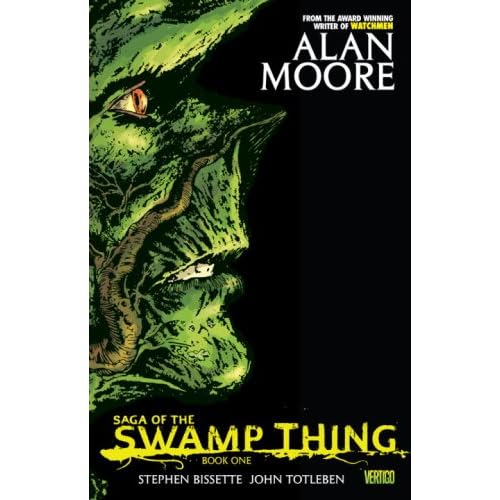
I finished Alan Moore's Swamp Thing and Writing for Comics as the next couple items in my Moore stack. I don't really have a scheme or patter for choosing to read what I read and in the order I read it. Because the things I have to say about works are, unfortunately, short, I've combined the two books into one post. You can thank Apple's hopelessly useless Safari program for this double feature. Some misguided times I try to use the stupid thing, and it crashes without fail if I try to do more than one thing quickly. For example, browse the internet AND have the computer on, or go to a website and sneeze. I should always use firefox.
Swamp Thing I'd always avoided. I watched the cartoon a little bit as a kid and had a few of the toys, my favorite being the one that turned bad guacamole dark green when cold and good fresh guacamole green when hot, like in water or sunlight. I'd always preferred Marvel's Man-Thing, who was innately more ethereal and based in horror tales about demons and forest spirits and stuff. Man-Thing came first, and Swamp thing about a year later. I knew someone was stealing from someone. Ultimately, I guess it was DC who stole from Marvel.
As far as I know, Swamp Thing started out as a Science Gone Wrong vaguely environmental warning. A man, Alec Hammond, ends up getting reconstituted as plant matter through the combination of dirty swamp water, a secret chemical compound, and an explosion. I had no interest. When I read about a year of Alan Moore's take, where Swamp Thing becomes a sort of lesser spirit god, my interest was piqued. My guess is that that's something Moore builds on later, because it was mostly vacant in this book. This book did have a reinvention of his origin – instead of Alec Hammond simply becoming a thing made of old roots and leaves, he dies, and his soul (more or less, the book doesn't use these words) inhabits the roots, and with the aid of that special serum, a man shaped plant thing with the memories of a dead human comes into being. In this book he fights one lunatic who wants to destroy the world with plants, and a demon. The setup for forest god is easily forseeable.
Moore works in homages, as established in the last post. So I'm going to get that out of the way first: the second story involves a battle with a demon named Etrigan, a Jack Kirby creation, complete with a dedication to Jack at the end of the book. The art is also an homage to the old Creepy Comics style artwork: very scratchy, lots of lines. The art fits the book perfectly, and I stopped many times to admire the artists' (though I think the inks show better than pencils) skillful rendering of haunted plants. It really reminded me of Sam Kieth's run on Sandman.
As far as story is concerned, this one was much more straightforward than probably any other Moore book I've read. There wasn't a fleet of characters to remember, and they're introduced in small groups allowing you to easily file it away. Since Moore wasn't there since the start, there are a lot of en medias res characters that I had to build partial profiles for simply because I wasn't there from the start. The book really only has about five characters to keep track of, which is much easier than Tom Strong's ever growing cast, or Watchmen and League's ponderous casts.
I don't really have much else to say about this one. It didn't have as much Moore token weirdness, though I know he takes it in a progressively darker and inward direction. I don't even really know if this was worth typing because there weren't many Moore techniques I could mine or anything. I honestly found myself more routinely impressed by the art and less by the story. Maybe when I read following volumes I'll have more interesting things to report.
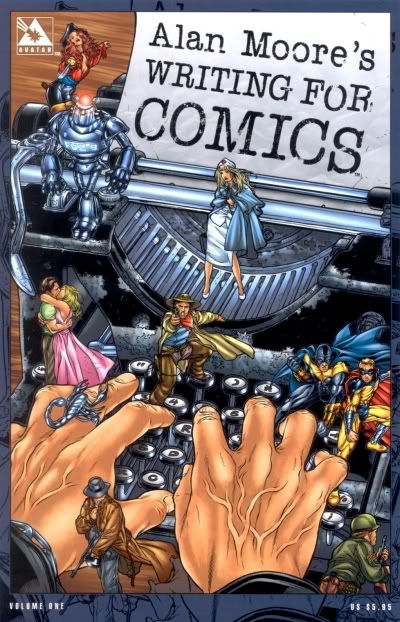 I was really looking forward to Alan Moore's Writing for Comics, but I was kind of disappointed. There's a series of perplex things happening with this book that I first want to address. The first is that it's almost five years old and it says volume one on the cover, and there is no sign of a volume 2 having ever existed in the history of ever. The only publication date listed in the book is 2006, but an afterword letter dated in 2003 references the work as being fifteen years old, which isn't inherently awful, but I feel in some way slighted – like the book was trying to deliberately keep the piece's age away from my attention. So apparently it was written in 1988 though nothing about the book's afterward and simple math belies that impression. Whatever.
The next thing is the art. I'm not sure why it's there. Maybe so the reader doesn't forget that Alan Moore draws for the funny books? But that makes no sense because if you're reading this book, there's no way you don't know who Moore is. And the art's pretty awful. It's not awful in the Dirty-Hippy-At-ComiCon-Who-Tells-Me-I-Don't-Even-Have-To-Know-How-To-Draw-To-Make-Comics kind of awful, though his art is among the worst I've seen seek publication, but awful in the Art-Is-Such-Standard-Comic-Art-That-It-Almost-Feels-Like-It's-Making-Fun-Of-Itself kind of awful. And they have nothing to do with what Moore's talking about. It might be better if they in some way did, though I'm not sure how that'd work, but they're ridiculous. On page talking about pacing you have a gladiator in a little box, then in another page talking about the believability of the world there's a cartoon man being drug along on a leash by a cartoon dog in horrible generic cliché comic art. It's not even good. And it's so forgettable. The only art I remember is the very end which has a picture of a man and woman kissing, and it's only because I vowed I would remember one image by the end of the book, or my name wasn't whistling dixie, and I forgot until I got to that last image. It sucked like the rest.
The book itself wasn't all that hot either. I constantly felt like Moore was gearing up to tell me something amazing, but never quite got there. That might be the same sort of thing as Swamp Thing (whose art was AWESOME) wherein it's merely the first volume. Supposedly. Unfortunately, whereas Swamp Thing got to go on with more volumes, it appears Writing for Comics did not. Most of what Moore said are things that I internalized long ago. Maybe if someone who hasn't had as many writing classes as I had, or who hasn't been reading comics as long as I have, or someone who pays less attention than I had read this book they would have thought it was amazing. But a lot of felt like rehash. Which I wasn't anticipating. Moore tells us on the first page he doesn't want the book to be a “How To Write Like Alan Moore” tutorial, which isn't want I wanted, but I suppose I expected something a bit more exploratory than this books alloted forty pages. I was honestly expecting a novel when I ordered this book from the library.
Some of the things I had already internalized that Moore mentioned were things like making sure you realize what you're doing; everything has a purpose and when you break from that purpose, make sure you know why you're doing it. There were even some things that I know, but he worded in ways that made it a little more succinct in my mind (which was cool). For example, he said there's a different between story and plot. Story seems to be a larger more nebulous concept. In the literary world, it would be called theme. It's the thing that connects this particular story, or plot, to humanity at large. And even if you're dealing with something silly, like elves, makes it relevant to the human condition. Plot is the particular sequence of events in that story. To use a familiar example, Finding Nemo is a story about the nature of father-son relationships, whereas its plot would be about a little boy fish getting lost in the ocean and his dad trying to find him.
Another thing Moore talked about was scale. His advice was to imagine the large details of a story and progressively work towards the most exact details until all of a sudden, you have a story. Start with the world: the time, where it's located, all the factors that went into the world. What's it's political climate? Is there a war? What events happened in the past to form the current world? Is it a totalitarian world? Is it primitive? Do they love TV? On and on. He says this is the most time consuming part of story creation, but makes the rest go smooth and comparatively faster.
Next, you'd develop your characters: everything about them and how they fit into this larger scope around them. From there, the plot is essentially the natural expression of the world and characters over time. In my book I wrote that P=(W*C)/T. Moore's advice is to think of plot like a four-dimensional construct, where the fourth dimension as time: each panel or situation is a single 3D slice operating within a 4D construct. His writing about plot was the most informative and enjoyable of the book.
In a 40 page book I only took a page of notes. Which is not a very good rate. My sincere hope is that he visits this concept later with more information. Then it might not suck so bad. I guess we'll see.
Subscribe to:
Posts (Atom)